Infrastructure in Disney World
A story about Cinderella, Tomorrowland, Utilidors, and Mosquitoes

In December, I did something I had dreaded for a long time. I went to Disney World in Orlando (Florida) with my four-year-old daughter.
Whether you're a fan or a foe of Mickey, you should enjoy this story and learn a thing or two about infrastructure. At least I did.
This is a story about my experience at Magic Kingdom.
The Anticipation
For Americans, going to Disney World might have become a patriotic duty. The two places every American should visit before they die are Washington, D.C., and Disney World.
Mickey has become the king of the USA. No matter the cost, everyone must pay tribute. If all Brits must see Buckingham Palace, all Americans must see Cinderella’s Castle at Disney World.
I did not sleep well the night before going. I tossed and turned and kept checking the clock. I spent a fortune on tickets to spend one day in Magic Kingdom. Seeing the king doesn’t come cheap, so I wanted to make sure we made the most of it. And I am not the only one complaining; see this New York Times opinion.
I had packed water bottles, ham and cheese sandwiches, hard-boiled eggs, cherry tomatoes, and some snacks to avoid wasting time in restaurants during lunch and dinner. I had made an itinerary with enough slack to accommodate unforeseen events (stochastic optimization, anyone?). And I had a fully charged power bank, as I knew my smartphone’s battery couldn’t handle the number of photos and videos I would take between 8 AM and 11 PM.
As I lay awake in bed in the middle of the night, I dreaded traffic jams on the way there. I dreaded long walks from the parking lot to the amusement park. I dreaded waiting in line for a ridiculously long time to enjoy two-minute rides. I dreaded my daughter giving me a sad face because she hadn’t gotten to see her favorite princesses. I dreaded expensive toys and large crowds and nasty people and bad weather.
However you feel before you start a relaxing experience, I felt the opposite. But I was ready for combat.
As Nelson Mandela said: “Courage is not the absence of fear, but the triumph over it. The brave man is not he who does not feel afraid, but he who conquers that fear.”
I feel bad quoting Mandela for a visit to Disney World, but I’ll argue the parallel wasn’t that far-fetched for me. If only I knew that the infrastructure nerd in me was in for a surprise.
The Beginning
On my way there, the traffic was surprisingly smooth. I only had to wait in a short queue to pay for parking. Disney’s traffic engineers are good. Optimization runs in their blood.
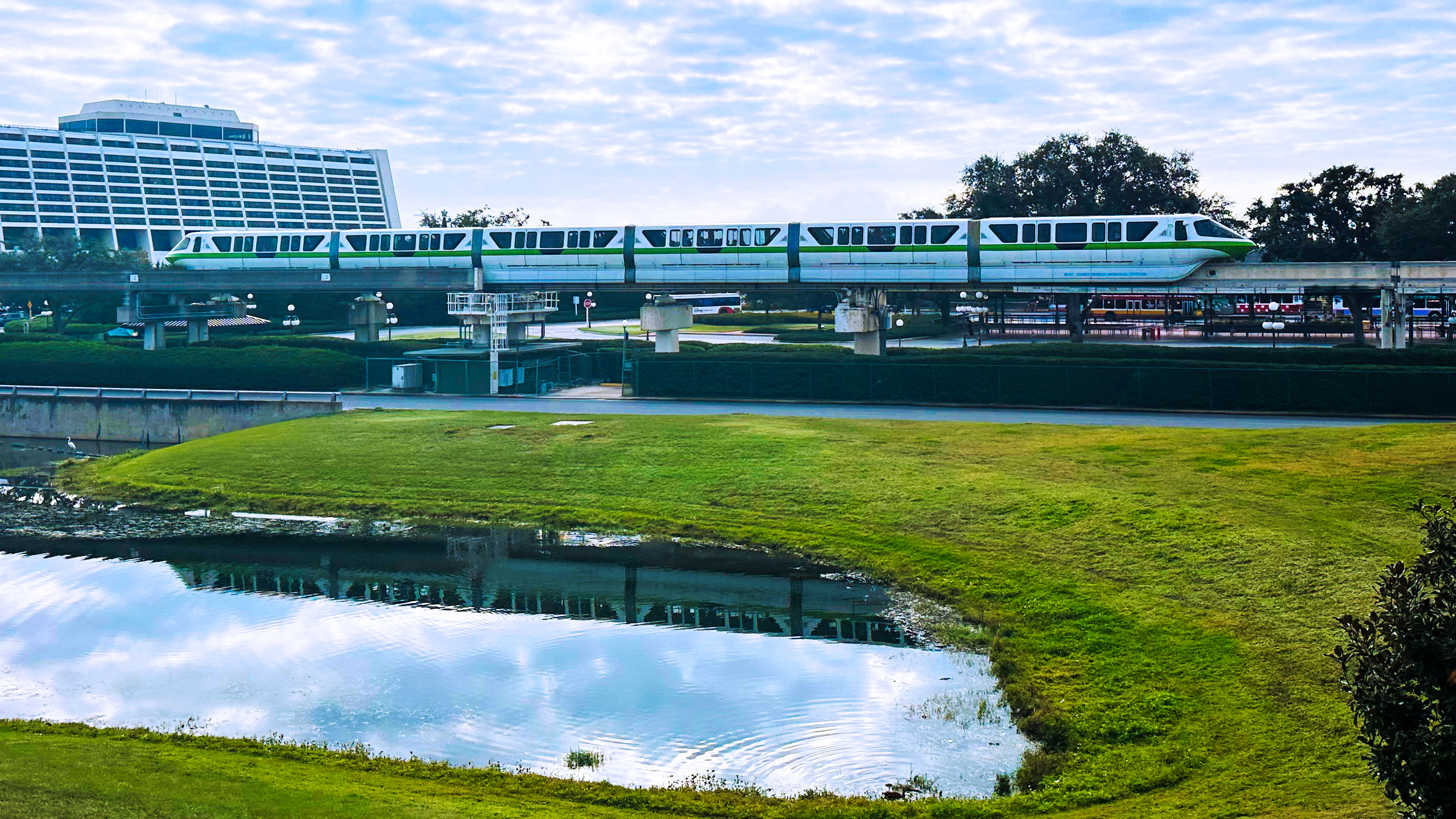
After parking, we headed for the famous Walt Disney World Monorail System to travel to the Magic Kingdom.1 There was an issue with the monorail, and we lost twenty precious minutes on the platform. Disney’s engineers may not be that efficient after all.
To distract myself from the stress while waiting, I kept thinking about how aging infrastructure inevitably deteriorates, even in magical places like Disney World.
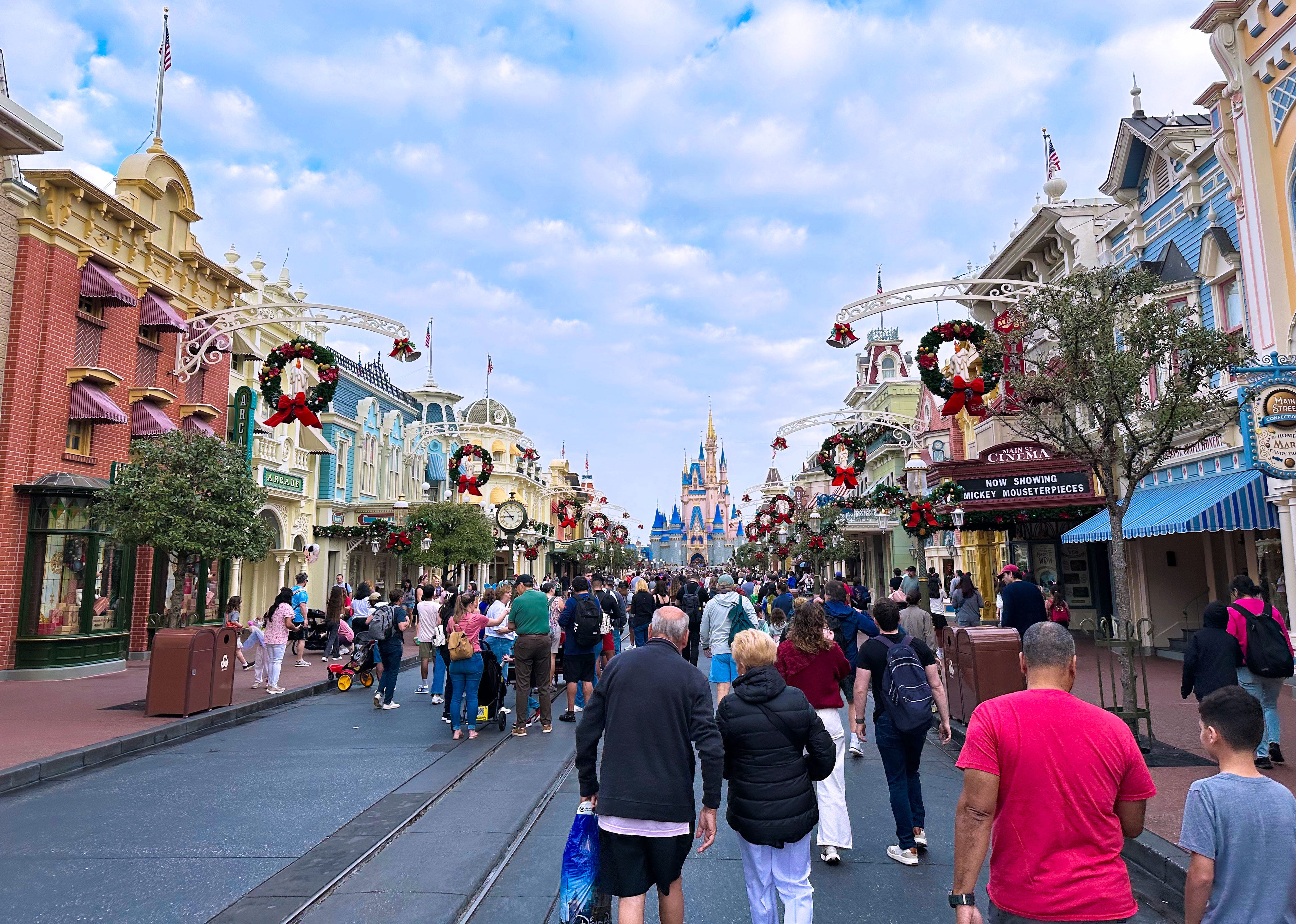
Once in the park, we first walked along colorful Main Street U.S.A. With its fake city hall, fake chamber of commerce, and fake theater, but real restaurants and very real many, many shops, it looked like a fancy street from an old Western movie.
The first photo above features Main Street U.S.A. with Cinderella’s Castle in the distance. It was busy. People were cheerful; I was on a mission.
As an interesting piece of trivia, Cinderella’s Castle is 189 feet tall (57.60 meters) as federal regulations required that buildings over 190 feet have a safety flashing light for aircraft warning. That’s why the castle isn’t taller.
The Attractions
Back to Main Street U.S.A., there is a rail station for a fake real2 steam engine railroad that transports riders to Tomorrowland, where I spent a good part of my morning.
Tomorrowland was my favorite area in the park.3 If you’re into infrastructure, that’s the spot for you. Many attractions are literally urban infrastructure. I want to emphasize three attractions.
The first one is the Tomorrowland Transit Authority PeopleMover. As a form of Personal Rapid Transit (PRT),4 it is a small elevated railway that carries riders in a loop above Tomorrowland.
Like many other attractions, before boarding, riders walk on a moving walkway (like those in airports) that moves at the same speed as the vehicles, so the vehicles don’t have to stop.5 The small vehicles are blue and open to the air. It was fun to cruise around the park, see people from above, and feel the breeze.
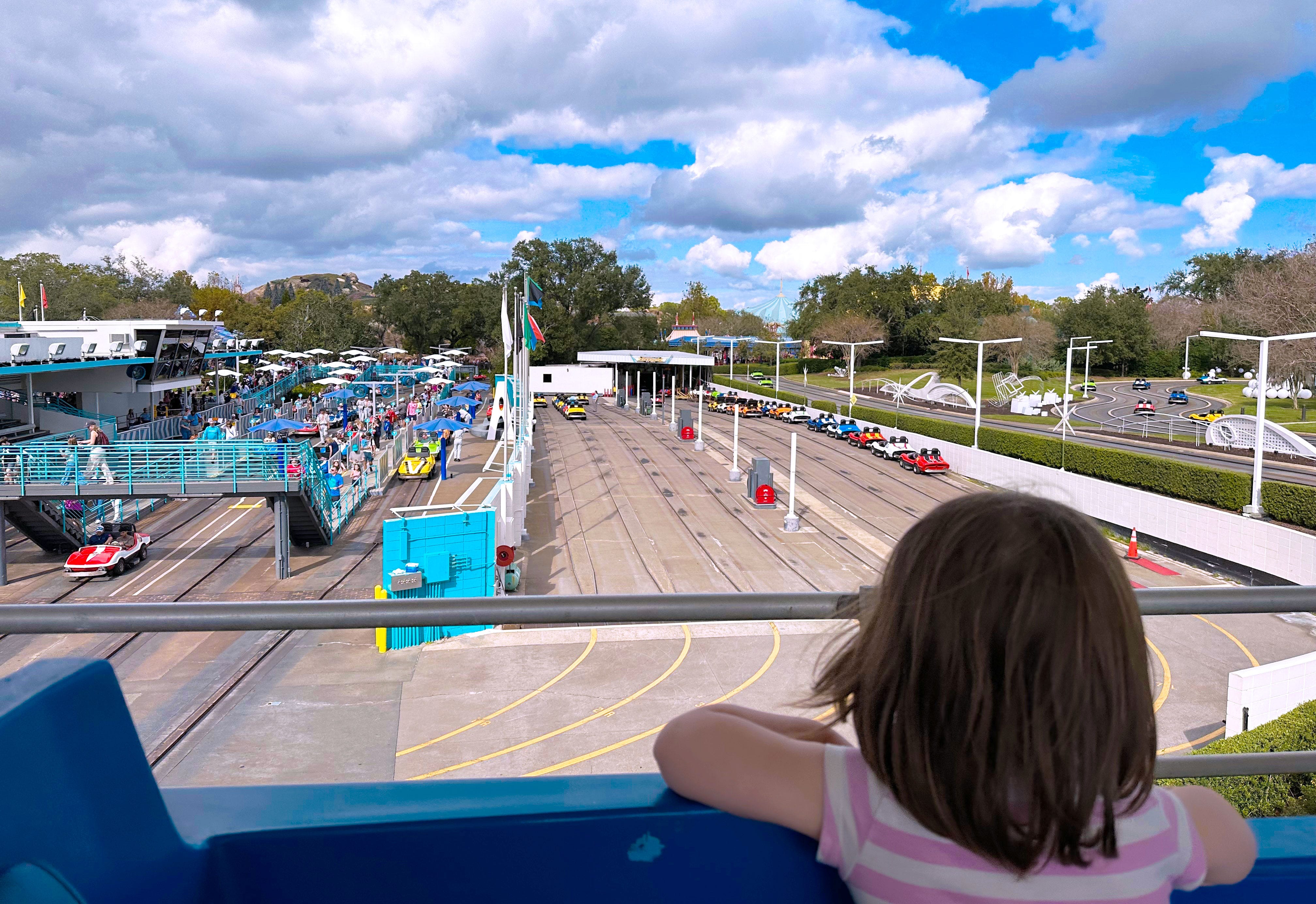
The second attraction is Tomorrowland’s Speedway. It is a mini expressway with small gasoline-powered cars (like go-karts). The cars are bright and colorful (see the picture below). While every car has a steering wheel, a central guide forces riders along a path, regardless of which way they steer.
My four-year-old loved it and made sure I didn’t touch the steering wheel,6 which meant we kept bumping the central guide. I laughed a lot; she was focused.
While driving was fun, waiting wasn’t. Fumes from car exhausts made me appreciate modern, cleaner engines.
The third attraction I want to mention is Tomorrowland’s Carousel of Progress. It’s one of the park’s oldest attractions and reportedly the longest-running stage show in American theater history.
The audience sits in a theater that rotates around a central stage from one scene to the next. There are four scenes; each takes five minutes. The audience gets to see how technology (and infrastructure) has evolved in a typical American household since the early 1900s.
From a hand pump to a water tap to a dishwasher: technology has evolved tremendously, but people haven’t.7 If you are interested, you can watch the entire show here (not filmed by me).
The Infrastructure
At that point, I realized that Walt Disney was not only an animator, but also an urban planner and a futurist. That’s not something I expected. Like many during his time, he loved technology.
From attraction to attraction, and from princess to princess, my mind naturally turned to the infrastructure needed to run the park.
Disney World is a city in itself. The entire complex includes four parks (Magic Kingdom, EPCOT, Hollywood Studios, and Animal Kingdom) and many resorts.8
If you don’t believe me, consider the fact that Disney World covers 110 square kilometers of land. That’s five square kilometers over the city of Paris. My thirteen-year-old nephew taught me that while we were in Florida.
Still not convinced? What if I told you that Disney World consumes over one billion kilowatt-hours of electricity per year, which is comparable to the electricity consumption of cities like Minneapolis, Pittsburgh, and Fort Lauderdale (see the data).
Most of the electricity is generated from natural gas, provided by Duke Energy and operated by Reedy Creek Energy Services.
Despite some meaningful efforts – have you seen the Mickey Mouse-shaped solar farm near EPCOT? – Disney’s greenhouse gas (GHG) emissions from electricity use are very high.9
What I didn’t know during my time in the park, but later learned, is that Magic Kingdom has a network of utilidors.
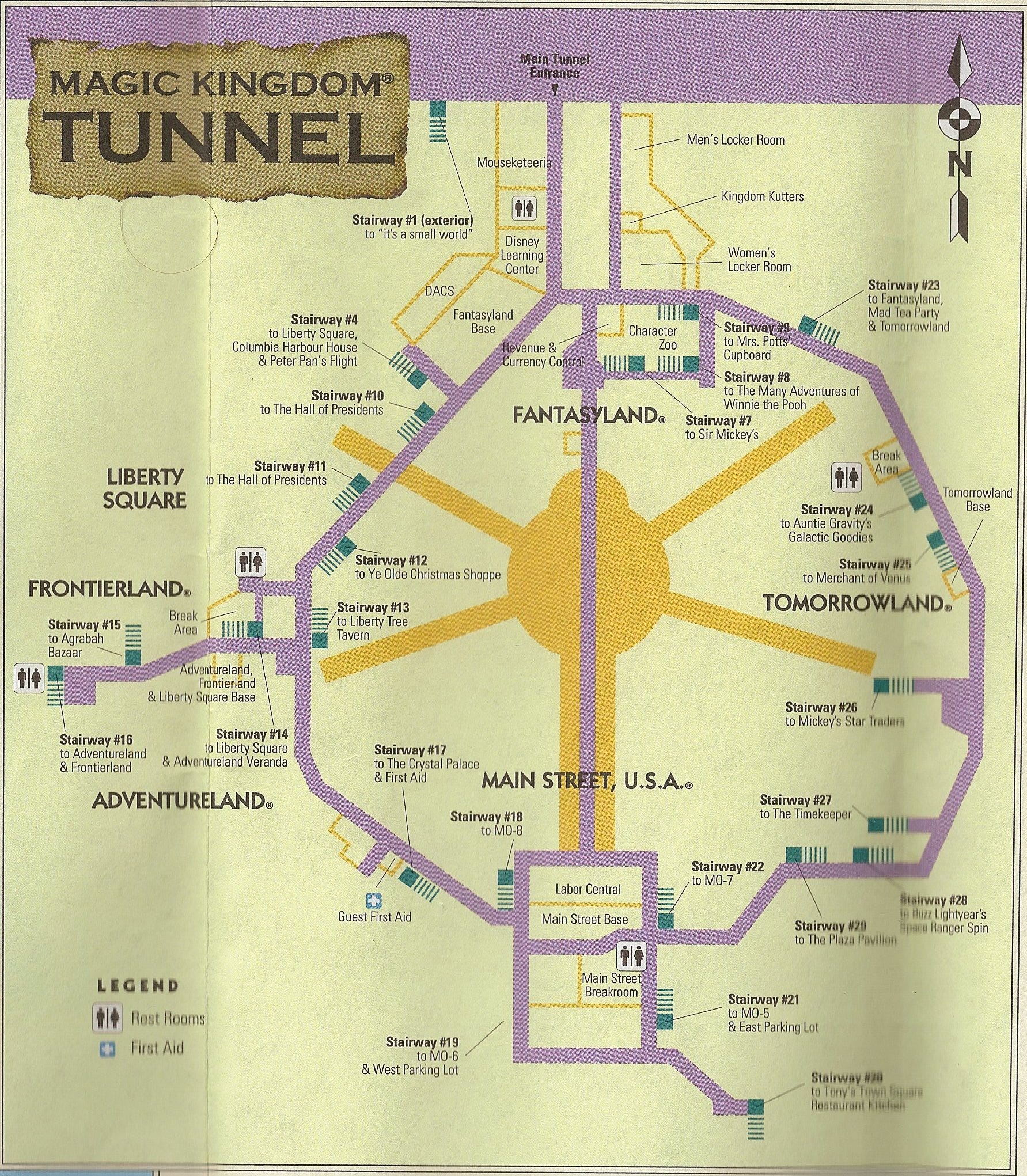
Utilidors are underground tunnels used not only for power lines and water conduits, but also for cast members and characters, so they don’t have to walk in the park in areas they don’t belong. Disney World is the only park with utilidors.10
The photo below shows an older map of the utilidors. The purple lines are the utilidors. The yellow lines are the main walkways in the park.
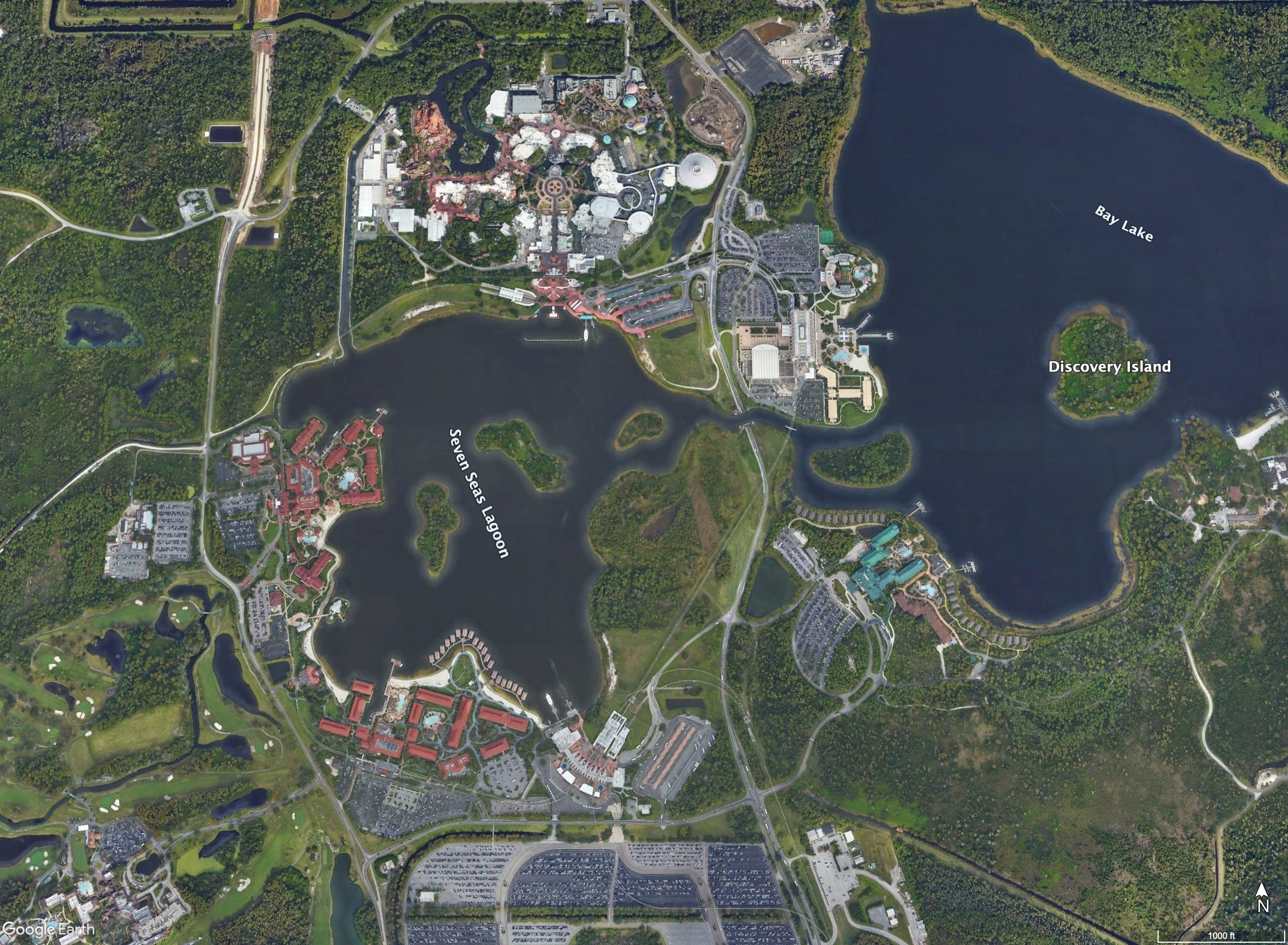
The utilidors were built by infilling soil excavated during the construction of the Seven Seas Lagoon. The large lagoon at the center of the complex, shown in the satelite picture below, is man-made. It is surrounded by resorts, the massive Transportation and Ticket Center (TTC) to the south, and the Magic Kingdom to the north.
The Seven Seas Lagoon is part of a massive system designed to drain swampland and ensure that all water bodies have continuously moving water. This major project was undertaken by General Joe Potter (former Governor of the Panama Canal Zone).
The drainage system also helps prevent mosquitoes from breeding. You won’t get stung at Disney World thanks to a slew of strategies that don’t include pesticides, but that include garlic. Isn’t that crazy? Florida is such a hot and humid place.
This also means that while they’re underground, the utilidors are located on the first floor of the park. Where visitors walk, one level up, is the second floor. Like Chicago, raising the park was inevitable since the ground level was swampland.
The utilidors also host the Automated Vacuum Collection (AVAC) system. It is a pneumatic trash system. Look well in Disney World. You won’t find any trash on the floor. Managing solid waste perfectly is paramount to the Disney experience.11
The End
There is much more to write about Disney World’s infrastructure. It is a good example of a planned city. Fortunately, if you are interested to learn more, the internet contains a wealth of information.
While researching for this story, I came across The Mouselets, a trio of siblings who love Disney and are active on social media. Luckily for us, Mouselet 2, a long red-haired, blue-eyed woman who seems to come out of a Disney movie, is a passionate civil engineer. I learned a great deal from watching her YouTube videos. That’s a piece of magic from Disney that I didn’t expect.
We’re now getting to the end of this story, just like I got to the end of my day.
After the stunning firework display and the night parade, I was ready to go back to my rental car. This time, I used a ferryboat to experience another type of infrastructure. I was exhausted and relieved. My daughter had a great time. She saw all her favorite princesses, got their autographs, and took a picture with them.
I wasn’t unhappy because I had gotten my infrastructure fix, but did I enjoy my time at Disney? No, definitely not. Considering the price of Disney tickets, I felt pressure to make the most of my time there, which meant prioritizing efficiency over enjoyment. I don’t plan to come back anytime soon (damn you, utilidors, they’re the only reason I would return).
I came to think of the expensive entry tickets as a form of taxes. Cities use tax money to build, operate, and maintain their infrastructure. Similarly, Disney World needs money to build, operate, and maintain its infrastructure. I assume this money comes largely from ticket sales.
As I drove to the hotel with my daughter soundly sleeping in the back, dreaming about the stuff kids dream of after spending a day at Disney World, I understood why tickets are so expensive. Disney World offers a perfect experience. I have never seen such rigor.
While I understand why people love Disney, given how much I pay in real estate taxes, I'm happy Chicago isn't run like Disney World; otherwise, I’d be broke.
Thank you for taking the time to read this story.
Please share your comments and thoughts with me through Substack or by email.
For more content about infrastructure, read The Infrastructure Book. Get it for yourself or ask your public/university library, or your company, to buy a copy so many can enjoy it.
Thanks to everyone who has read it already and left a positive review online.
The main parking lot is far. Everyone must either board the monorail or a ferryboat to access the Magic Kingdom and other parks.
A reader corrected me. The railroad features a real steam engine, powered with biodiesel.
My daughter’s favorite attractions were… drumroll… meeting princesses. In particular, she loves Cinderella and Rapunzel.
London’s Heathrow Airport has a great PRT that I have ridden many times.
But the vehicles accelerate once they leave the station.
This time, she was the one driving, and she had a lot of fun. But I was the one accelerating. Every vehicle has a single pedal on the floor.
The attraction makes you feel that way. In every scene, despite technological progress, the main character kept burning the Christmas turkey.
No, I did not stay at a Disney Resort and did not visit other parks.
The area’s power grid emission factor is over 500 g CO2e per kWh according to electricitymaps (a great resource), which is on the higher side.
The story goes that Walt Disney shrugged when he saw a cowboy walking in Tomorrowland at Disneyland in California. Cowboys are a thing of the past. They have no place in Tomorrowland. Underground tunnels ensured that characters could walk through the park without being seen. In newer parks that aren’t in swampland, to avoid excessive digging costs, a series of backstage areas is strategically planned.
My nephew learned from a documentary that Walt Disney loved eating hot dogs. He would get one at a stand and eat it while walking. When he was done, he wanted to make sure there was a trash bin not far.