
Pole Reading
Restoring respect for utility poles

On a scale of 1 (low) to 10 (high), how much do you like utility poles?
By utility poles, I mean those tall poles with messy wires that are usually relegated to back alleys, like the ones shown below. How much do you like them?
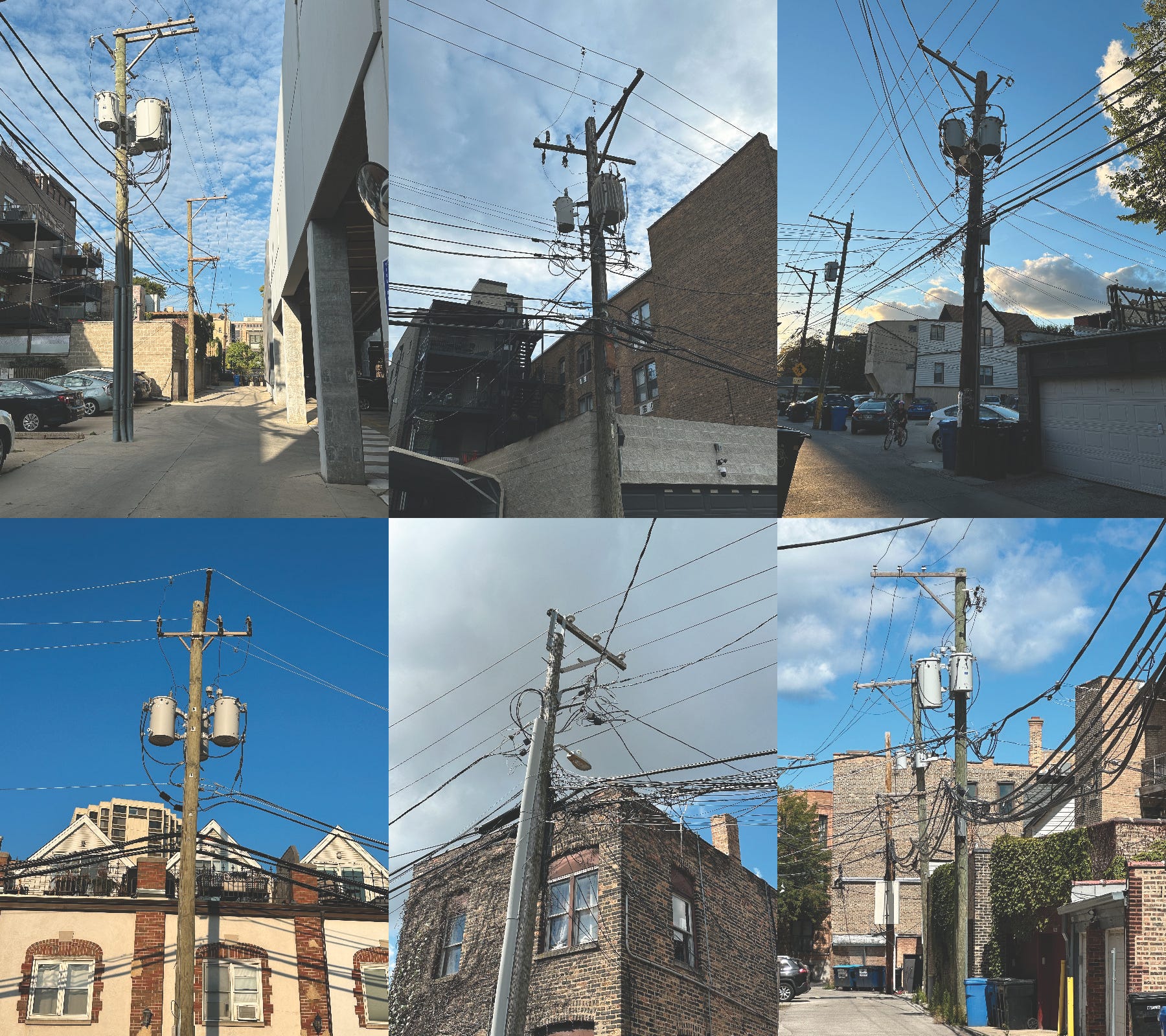
My guess is your rating is closer to 1 than to 10, and I think it’s unfair.
Sure, poles aren’t pretty. You won’t get an hour-long architecture talk about the aesthetics of utility poles. Cities hide them however they can. Utility poles are eyesores. They get the same treatment as dumpsters. We’ve learned to forget them, to assume they don’t exist.
The reality is that our lives depend on utility poles. They are the physical links that make our virtual connections possible. With no poles, we have no internet, no phone, no electricity. Few things in life are as important to us as utility poles, and we’re meant to ignore them? I don’t think so. Ignore them no more!
My goal with this story is to restore respect for utility poles. By learning how to read them, we can start to appreciate them. And once we appreciate them, no matter how messy or drab they look, we can see beauty in them.
Inevitably, this story is more technical. So be it. It’s the least we can do for such an important part of our lives. By the end, you won’t look at a utility pole the same way ever again. I promise it’s worth it. And if some parts are too technical, just skip them.
Let’s go!
The Hierarchy
In many countries, electricity and telecommunication wires are buried underground with water pipes, gas lines, and sewers. In many others, like in the U.S., they are hidden in plain sight.1
The most important thing to know about utility poles is the strict hierarchy.
At the top, we have the electricity zone. In the middle, we have the communication zone. At the bottom, we have the ground clearance zone. The gap between the electricity and communication zones is called the safe or neutral zone.
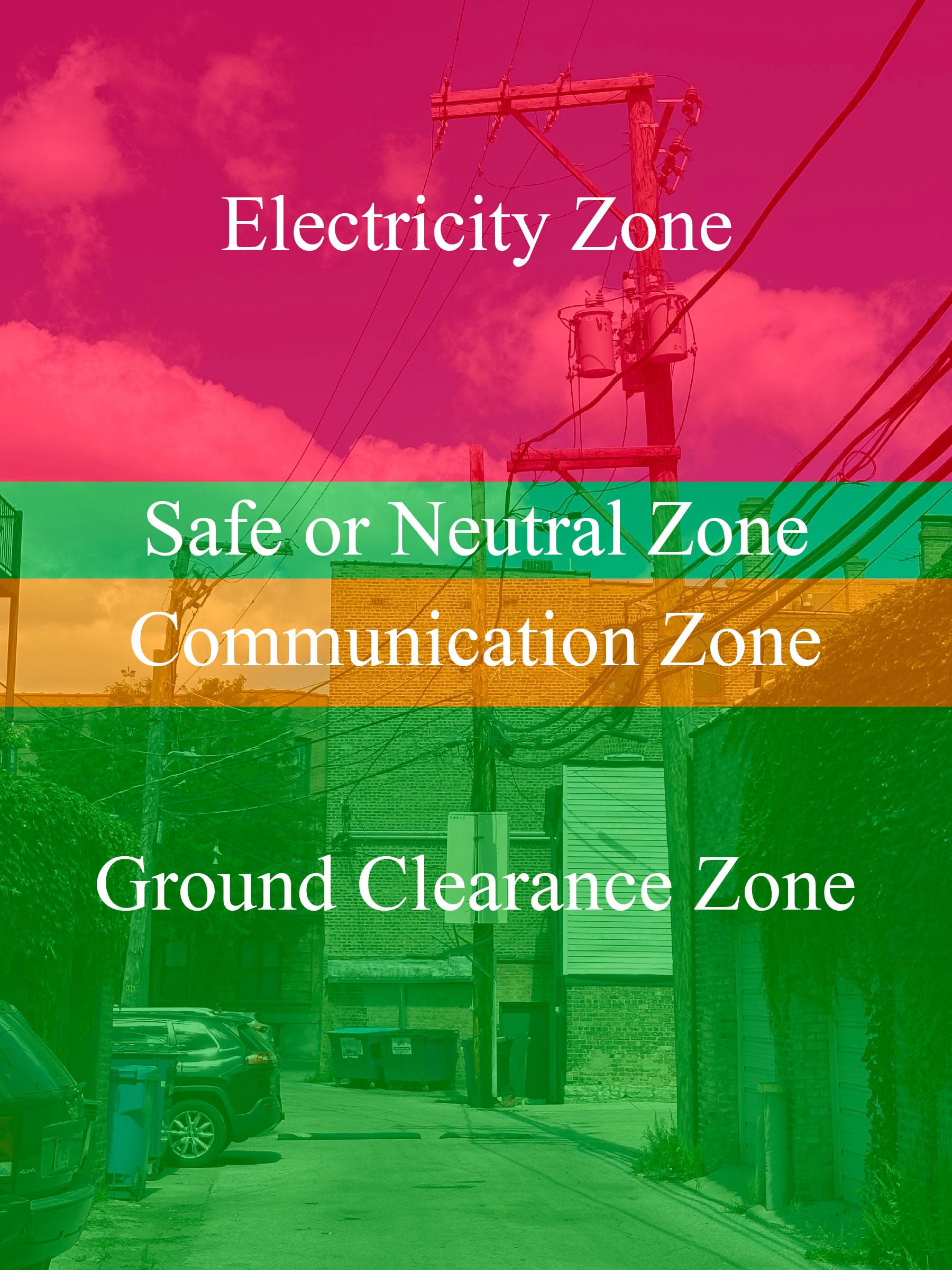
That alone is worth knowing. As both electricity and telecommunication infrastructure, utility poles are multi-functional infrastructure.
This hierarchy is important for safety. The top electricity wires carry high voltages. They are dangerous, and therefore, they are as far away as possible from people.
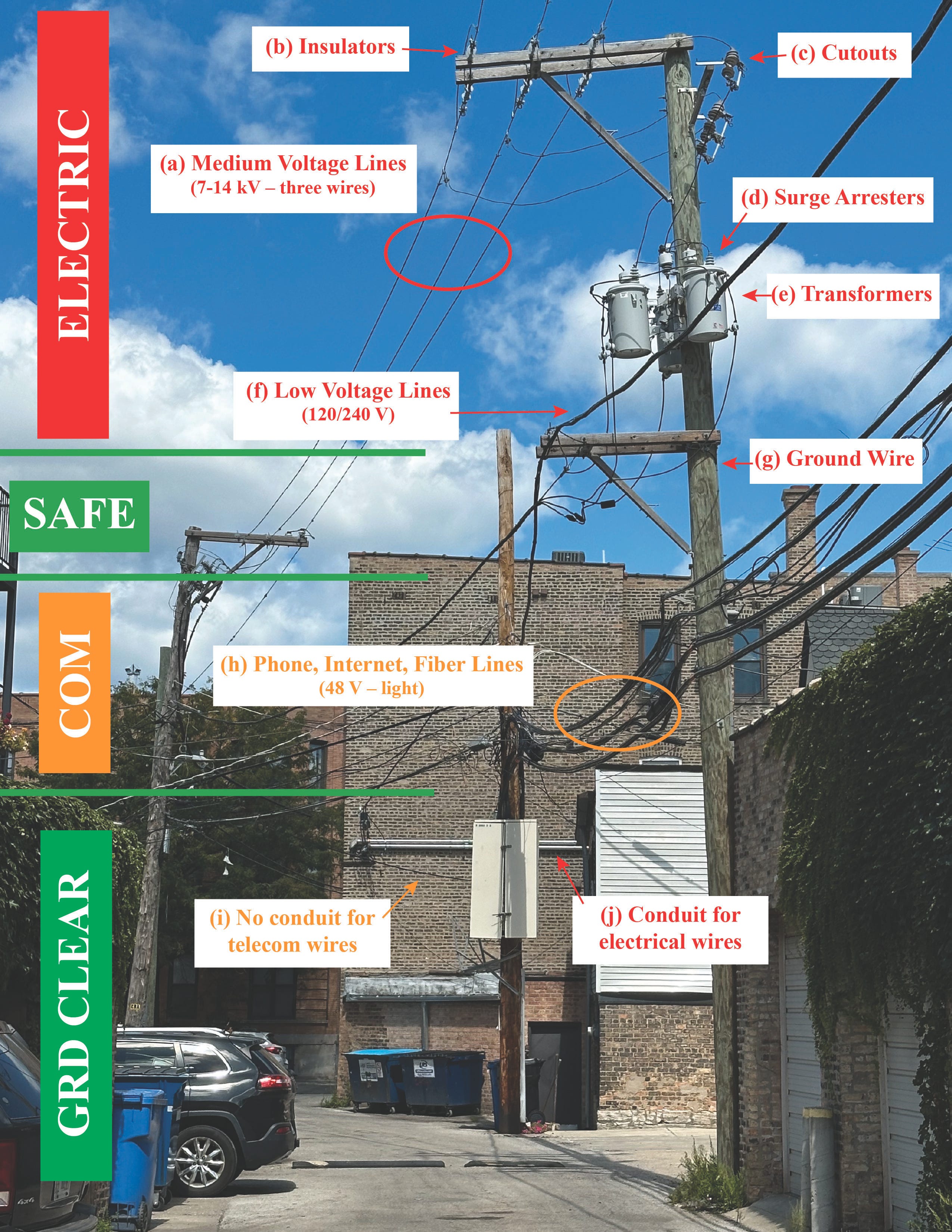
To dive deeper, let’s look at the example below taken from my neighborhood in Chicago.
I will comment on each element individually.
Electricity
The electricity zone is the more complicated one. It is divided into three systems. At the very top, we have the medium-voltage lines. At the bottom of the zone, we have the low-voltage lines. Between the two, we have the transformers that step down the voltage.
Medium-Voltage Lines
Medium voltage lines carry electricity usually between 7 and 14 kilovolts. A common voltage is 13.8 kilovolts (that’s 13,800 volts).2
The medium voltage lines (item (a) in the picture) always come in three. In the late nineteenth century, it was found that it was more efficient to produce three currents when generating electricity rather than one or two. It’s called three-phase power.3
The three currents are 120 degrees out of phase from one another, so a neutral line is not necessary.4
If you have read The Infrastructure Book – and I hope you have – you already know about three-phase power.
These medium voltage lines are connected to the poles through insulators (b), so the currents do not touch the poles directly.5
The medium voltage currents are passed to the transformers through the cutouts (c) (that melt if the current is too high during a surge) and through the surge arresters (d) (to protect transformers in case of lightning).
Transformers
The grey garbage-can-looking pieces of equipment are the transformers (e). They step down the voltage from 13.8 kilovolts to 230 volts in many parts of the world (including Europe) and 240 volts in many other parts, including in North America.
Now, I know what you are thinking. Isn’t the voltage 120 in North America? Why 240 volts? That can’t be right.
That’s where it’s going to get a tiny bit more technical.
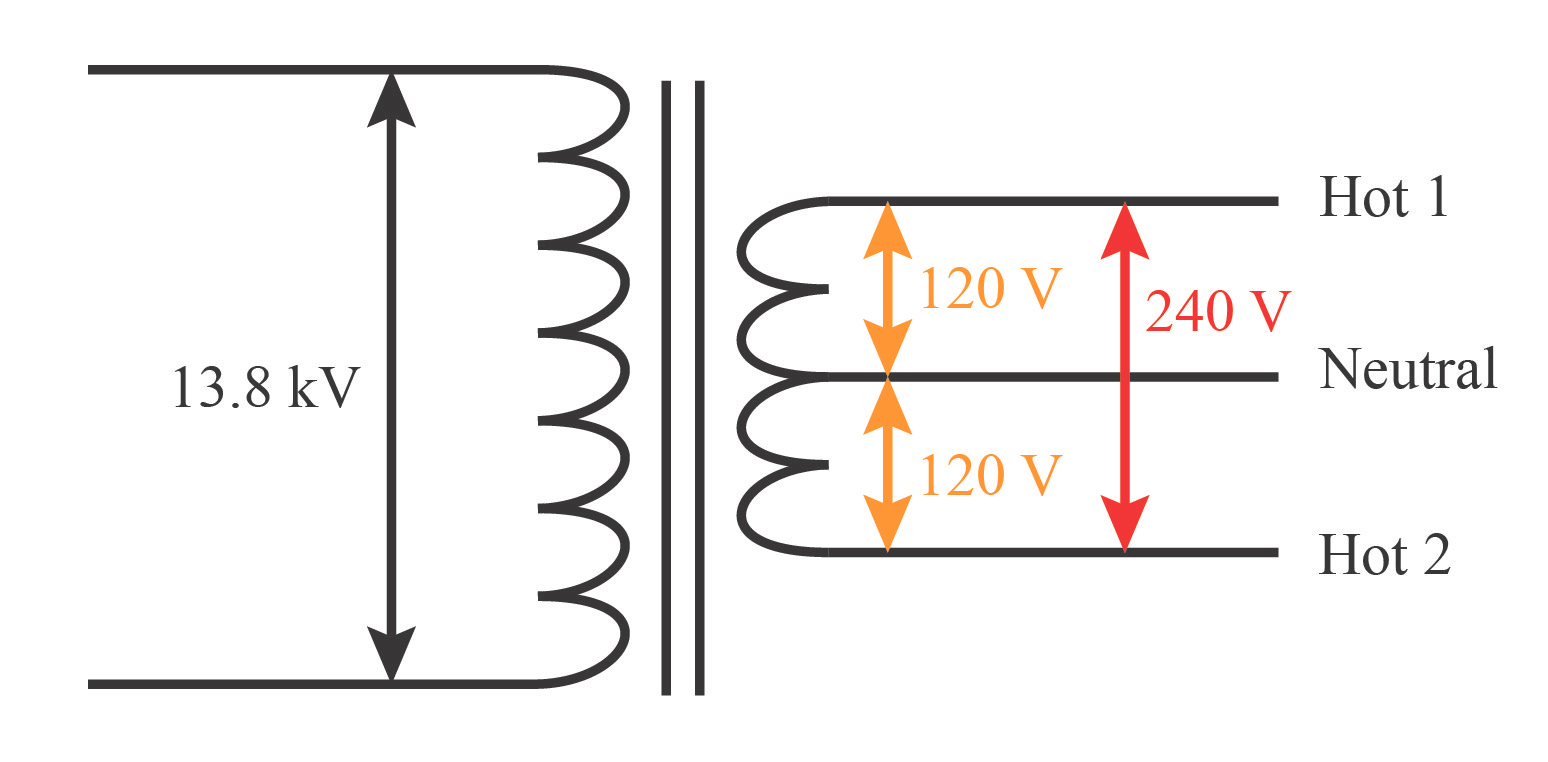
See the sketch below. On the left-hand side, we have the current as it arrives from the medium voltage lines. The middle part is the transformer.
On the right-hand side, we have the transformed current. Hot 1 is connected to the top of the coil. Hot 2 is connected to the bottom of the coil. In much of the world (including Europe), that’s all there is in a transformer (hot 2 is the neutral).
In North America, the neutral is connected to the middle of the coil. As a result, we have three possible currents: two currents with 120 volts (hot 1 to neutral and neutral to hot 2) and one current with 240 volts (hot 1 to hot 2).
That’s clever, isn’t it?
Low-Voltage Lines
The low-voltage lines (f) connect the utility poles to buildings. The lines are protected in metal or plastic tubes (item (j)) when they run along buildings, so people cannot get electrocuted even if they’re worn out.
If you are in North America, open your electrical panel. You will find two vertical panels with breakers for each of the two currents that carry 120 volts.
You may also see double breakers. That’s for appliances that run on 240 volts. Some larger appliances like central AC and electric stoves run on 240 volts.6
In places that run on 230 volts, like in Europe, electrical panels are generally horizontal.
The last point is the ground wire (g). A neutral is not needed for the medium-voltage lines, but it is needed for the low-voltage lines (to balance the loads).
The neutral line is also connected to the ground (g) to dissipate surges. That’s the wire that runs along the pole (in a casing for safety) and goes into the ground.
That’s it for electricity. It’s simple and complicated at the same time. The reality is that we don’t have one electricity system on utility poles, but three, and they’re always on the top of poles.
Telecommunication
The telecommunication system looks messier, but it is much simpler. Let me ask you a question first.
How is information transmitted in telecommunication cables?
When I ask my students, they give me blank stares. It’s not that they have an idea and think they may be wrong. They just don’t know. They have never thought about it.
We know that fiber-optic cables use light to transmit information, and there may be fiber-optic cables on the utility poles. But what about the others?
The answer is all too simple: electricity. But at lower voltages, which is why they are not as dangerous as electricity wires.
Three Types of Wires
We will usually find three types of telecommunication wires on utility poles:
Fiber-optic cables that transmit light
Telephone (or DSL7) cables that run on 48 volts
TV (or broadband) cables that carry voltages from 12 to 90 volts
Because voltages are much lower now, no plastic or metal tubing is required to protect people (item (i)). The cables can dance freely around and along buildings.
The image below shows the three types of connectors you may find at home or work.
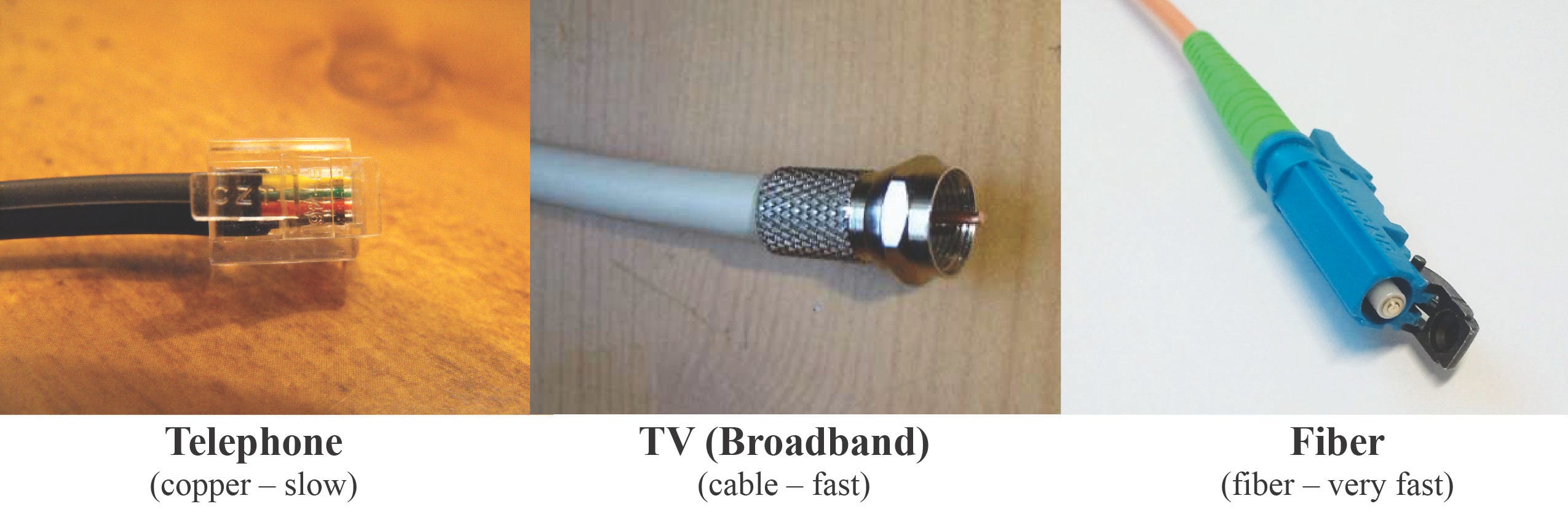
Telephone cables are often the lowest on the pole because they were installed first (to maximize the space between the electricity and communication wires).
Three Technologies
Telephone cables used to be the technology of choice to access the internet. Anyone who had a dial-up modem remembers the sound of connecting to the internet. Telephone cables have limited bandwidth.
Most people don’t have landlines anymore and don’t require a telephone connection. Plus, most people prefer faster internet speeds and opt for broadband.
Broadband piggybacks on the TV coaxial cables. That’s the cable with a circular metal piece and a needle in the center. Look at your modem or behind your TV. Coaxial cables have a larger bandwidth, hence the faster internet speeds.
Fiber is even faster than broadband since light is used to transmit information. While fiber is becoming more common, it will take time for everyone to have access to fiber because fiber-optic cables must be installed.
If you live in the US and want to know your internet provider options, visit https://broadbandmap.fcc.gov and enter your address. What you see may surprise you.
In addition to the name of the providers, you will also see the type of cable by provider: copper for telephone wires (slow), cable for broadband (fast), and fiber for fiber (very fast), and you will see your wireless options (including through satellites).
An Important Difference
One difference between electricity and telecommunication infrastructure is that there is only one electricity distribution system in cities, while there are several telecommunication systems.
Even if you can select different electricity providers, they all use the same wires. It wouldn’t make sense to have multiple systems because the equipment takes up space and is expensive.
Telecommunication is different. Because the internet needs a system that can transmit digital information (on or off), legacy telecommunication companies could adapt their existing infrastructure.
That’s why AT&T used to be purely a phone company and Comcast used to be purely a TV company. The same cables used to make a phone call or watch TV can be used to surf the internet.
Fiber is different. We don’t have legacy fiber-optic cables going to every building. It requires new infrastructure – that’s millions of kilometers of cables – which is why it’s taking longer to make fiber available to everyone.
In Chattanooga, TN, the main internet provider is EPB, the local electric utility. The company invested in fiber and became the main internet provider. But that’s a story for a future post.
So? What do you think?
Did I deliver or did I overpromise? I know I threw a lot of information at you.
Do you appreciate utility poles more now? I hope you have at least learned to read them.
If I did my job, you should be curious to open your electrical panel now, or walk outside to see what your utility pole looks like.
Go for it and take your smartphone or tablet with you so you can compare the example above with your utility pole. You can find an unlabeled version of the picture above in the gallery page of my website.
You might still not find utility poles sexy, but it’ll grow on you. I know that’s what happened to me.
If you remember just one thing, it should be the hierarchy: electricity, communication, ground clearance.
If I have whetted your appetite and you want to know more about utility poles and see more visuals, I recommend this link, this link, and this link. Also, make sure to check the footnotes.
If you want to get into the details and learn about pieces of equipment sometimes present but not discussed here (e.g., splice cases, repeaters, amplifiers), I recommend this document from the Delaware DOT.
Finally, if you want to learn more about transformers, I found this video helpful.
And, as usual, if you have any comments or if I made a mistake, please write a comment on Substack or email me. I really appreciate the feedback and support I get after every post.
For more content about infrastructure, read The Infrastructure Book. Get it for you or ask your public/university library or company to buy a copy so many can enjoy it.
Thanks to everyone who has read it already and left a positive review online.
Underground is safer and more reliable, but also harder to repair when there is a problem.
Chosen to balance energy losses and equipment costs. A high voltage is preferred to minimize energy losses, but high voltage means heavier and more expensive equipment to step down the voltage to 240 volts.
To know about the history of three-phase power, this video is great.
The sum of the currents is always zero.
Wood is a good insulator, but water is not, and wood poles get wet when it rains. If the currents pass through the poles, they could overheat and catch on fire.
Higher voltage means lower current. High currents can cause wires to overheat and catch on fire.
DSL for Digital Subscriber Line. If you had one at home, you probably weren’t born this century.